DCIM · IPAM · IPMI · usage billing
Everything between the rack and the invoice.
The control plane for hosting providers and colocation operators: what you racked, who it belongs to, what it drew, and what to charge for it.
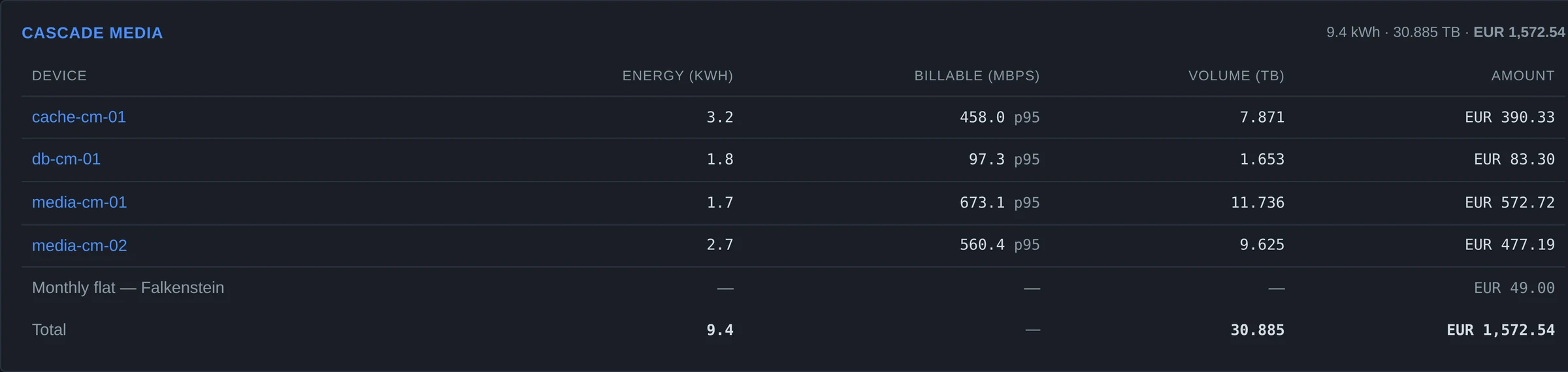
Devicecache-cm-01
Energy3.2 kWh
Throughput450.0 Mbps p95
AmountEUR 390.33
One line of one customer's month. Every section below earns one field of it.
No card. Every feature. Unlimited customers on every plan.
A box, a place, and an owner
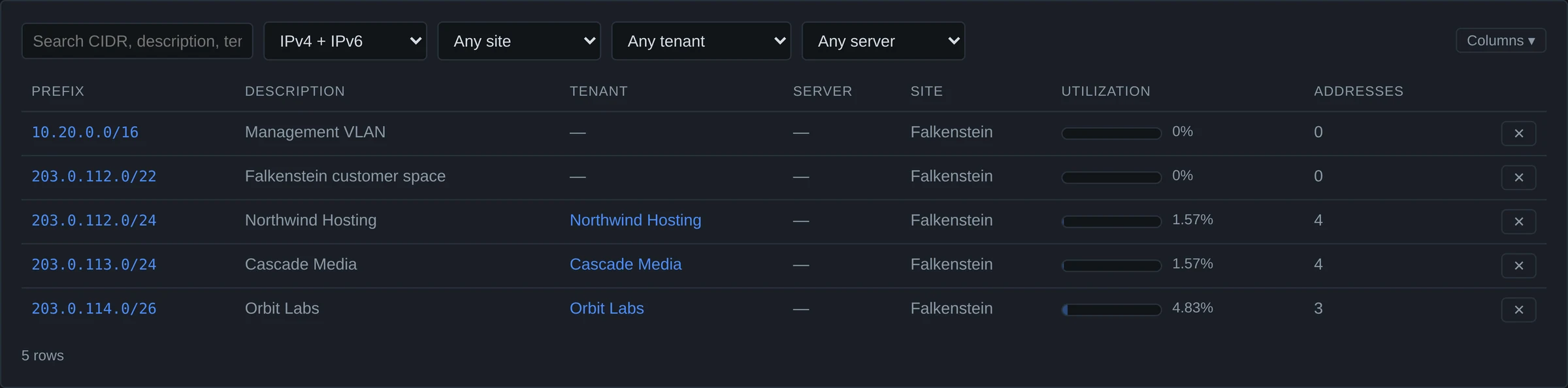
The line starts with a machine that exists. Sites, elevations, U positions, models and serials, and the addresses it holds, out of a real prefix hierarchy rather than a spreadsheet of free IPs.
- Racks and elevations, down to the U
- IPv4 and IPv6 with live utilisation
- Custom fields on any object, and an audit log of every change
- One outbound connection per site, nothing inbound to open
Every outlet, not just the strip
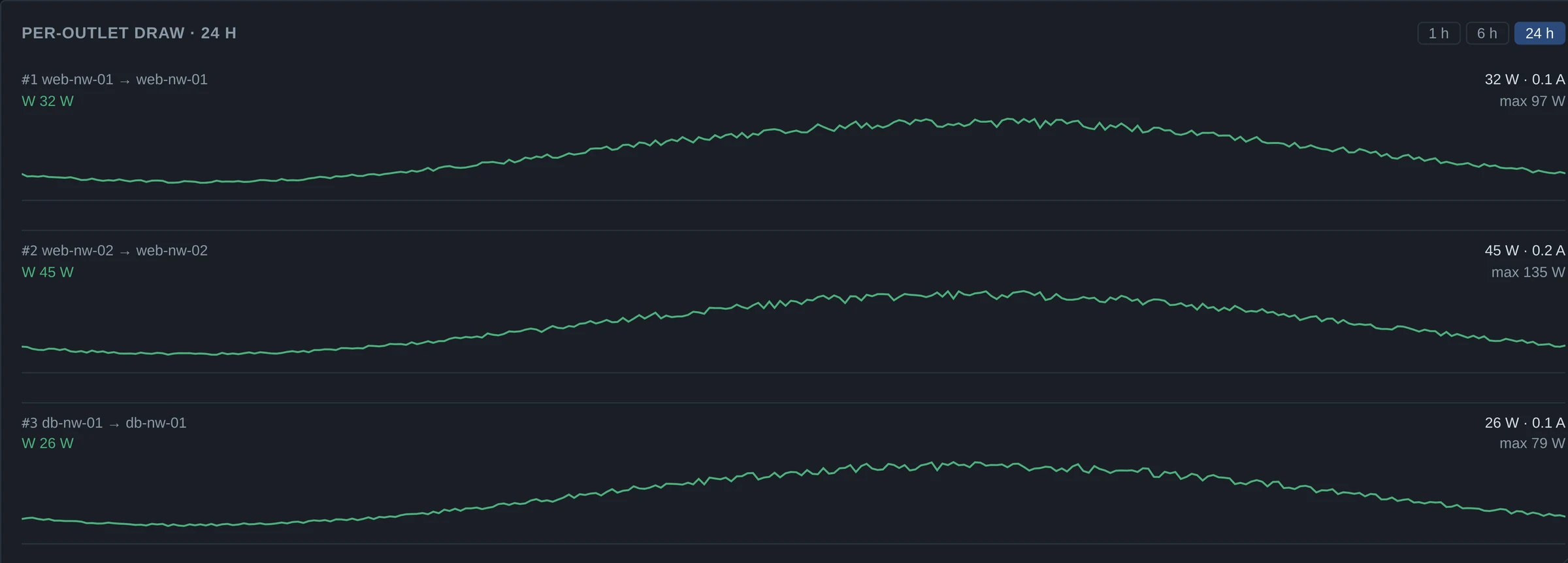
Each outlet is polled on its own and mapped to the server it feeds: the difference between “the rack drew 4 kW” and “this customer drew 71 kWh”.
- Draw and kWh for each outlet, not each PDU
- Hundreds of PDU and switch families, from the LibreNMS definitions
- Alerts when a device goes silent or a circuit runs hot
Counters, not estimates
Interface counters read straight off the switch, turned into throughput in and out, and a 95th percentile you can defend to the customer who asks how you arrived at it.
- Per-port counters over SNMP, polled continuously
- 95th percentile and monthly volume, per port and per customer
- The same figures your customer sees in their own portal

At your rates, in your books
Energy, billable Mbps and allocation priced at your rates, per customer, per month. Export the month, or raise it as draft invoices in your own lexoffice account.
- A closed month per customer, at rates you set
- Draft invoices you review; nothing is issued without you
- Everything the UI does, over the REST API, exportable whenever you want
The tickets you stop getting
Both of these are scoped to the customer's own machines, rate-limited, and written to the audit log.
Power and console
Most tickets an operator gets are “please power-cycle it”. Give them the button instead.
- Power on, off and cycle, on their own machines only
- A browser console with keyboard and mouse, nothing to install
- Boot-order override for the next boot only, then it reverts
- They never see a BMC password, and every action is logged
Reinstall and rescue
Arm a server against a boot image and power-cycle it. The site agent serves the loader and streams the kernel from its own disk, so a reinstall runs at LAN speed.
- Legacy BIOS, UEFI and UEFI HTTP boot from one arming
- Images cached at the site: reinstall without the WAN
- One-shot by default, so a box installs once and not on every reboot
- Progress reported back per machine: armed, served, booted
Built to sit in someone else's datacentre
- Nothing inbound
- A small agent at each site dials out over one connection. No firewall holes, nothing sensitive stored at the site.
- Credentials stay central
- BMC and SNMP secrets are encrypted at rest and handed to an agent for the length of one call. Customers never see them.
- Your data is yours
- Every change is in an audit log you can read, and a full export is one click away.
Who built it
By people who run their own racks
This started as the tool we needed ourselves. We operate colocation, and nothing on the market knew what an outlet, a prefix and a customer had to do with one another, so every month ended in a spreadsheet and a guess.
Everything on this page runs our own estate before it reaches yours. When a poller stops at two in the morning, it is our pager too.
That line, for every machine you run.
Thirty days, every feature, no card. Point an agent at one site and see what comes back.
Start a 30-day trial